
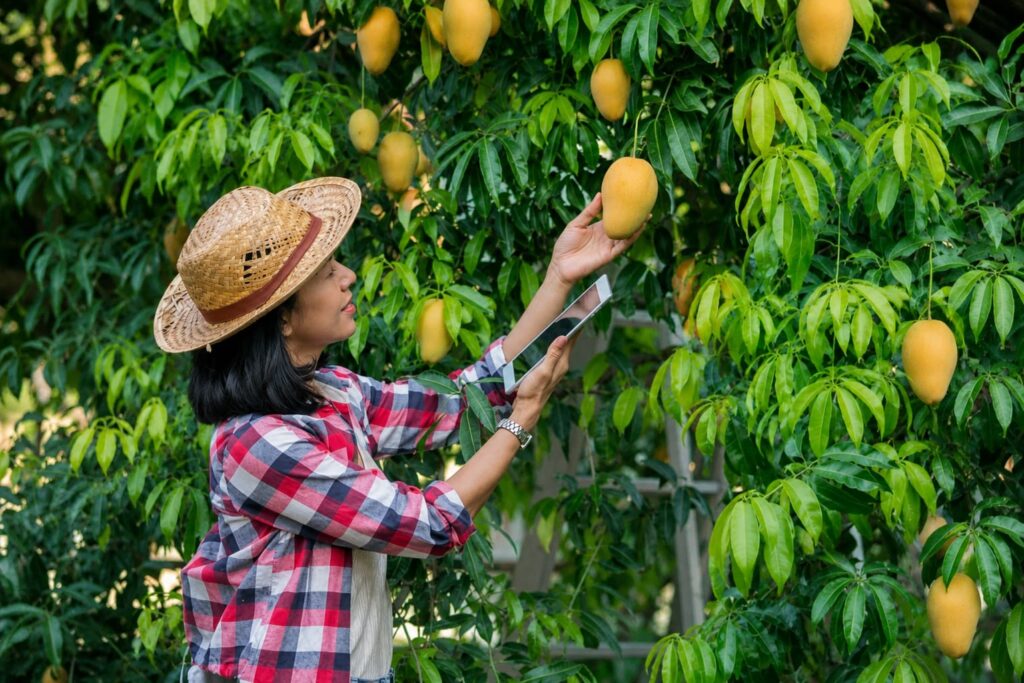
To grow better mango crops in India, precision fertiliser nutrition is the most important change a mango farmer can make. India is the world’s largest mango producer. But yield and quality inconsistency remains a persistent problem across most Indian mango orchards. Alternate bearing cycles frustrate farmers year after year. Panicle development is uneven. Fruit set percentage is lower than it should be. Fruit sizing is inconsistent. And post-harvest shelf life falls short of what export markets demand. Most of these problems are nutritional in origin. Yet most Indian mango farmers continue to apply the same urea and DAP programme they have used for decades without addressing the specific nutritional requirements of the mango tree at each stage of its annual development cycle. Floral Designs brings the complete Basfoliar range from Compo Expert Germany to Indian mango farmers. These are precision fertiliser products designed to deliver targeted nutrition at every critical stage of the mango crop cycle. So the tree gets what it needs precisely when it needs it most.
Why Mango Trees Have Specific Nutritional Needs
Mango trees are perennial crops with a complex annual development cycle. Unlike annual vegetable crops that complete their cycle in a few months, a mango tree carries the nutritional consequences of each season into the next. So a potassium deficiency in the fruit development phase of one season directly affects the tree’s capacity to initiate strong panicles in the following season. As a result, nutritional imbalances in mango orchards compound over multiple seasons and become progressively harder to correct if they are not addressed early. Furthermore, the mango tree’s nutritional priorities shift dramatically between its annual developmental phases. During vegetative flush, nitrogen and micronutrients drive new shoot and leaf development. During flower induction, low nitrogen and adequate phosphorus and potassium support the hormonal signals that trigger the transition from vegetative to reproductive growth. At panicle emergence and flowering, high phosphorus nutrition drives panicle development, pollen viability, and fruit set. During fruit development, potassium dominates. And calcium is critical throughout the fruiting phase to prevent fruit disorders and maintain post-harvest quality. So a nutrition programme that applies the same product at the same rate throughout the year is fundamentally unsuited to mango. Because it ignores the tree’s actual developmental rhythm completely. As a result, to grow better mango crops in India, the nutrition programme must be stage-specific.
Flower Induction Stage: Setting Up the Season for Success
The flower induction stage is where the mango season is won or lost. This is the period, typically from November to January depending on the variety and region, when the tree makes the hormonal transition from vegetative growth to reproductive development. Getting the nutrition right at this stage determines how many panicles the tree will produce and how productive those panicles will be. The key nutritional requirement at flower induction is a low nitrogen environment combined with adequate phosphorus and potassium. High nitrogen at this stage suppresses the hormonal signals that trigger panicle initiation. So nitrogen applications should be reduced or stopped in the weeks leading up to expected flower initiation. Furthermore, phosphorus and potassium nutrition should be maintained to support the energy demands of the reproductive transition. Basacote High K 6M from Compo Expert Germany is the ideal product for sustained potassium and balanced background nutrition through the transition into flowering. Its high potassium controlled release formulation delivers consistent background nutrition without the nitrogen surge that conventional granular fertilisers create at application. So the tree gets the potassium it needs for flower induction without the nitrogen suppression that would delay or reduce panicle development. Additionally, adding Basfoliar Kelp O SL as a foliar spray in the weeks leading into flower induction supports the hormonal signalling that drives the vegetative to reproductive transition. The natural cytokinins and auxins in this seaweed product work alongside the tree’s own hormone systems. So panicle initiation is more uniform across the canopy and more consistent from tree to tree across the orchard.
Panicle Emergence and Flowering: High Phosphorus Nutrition
Once panicle emergence begins, the mango tree’s phosphorus demand surges. Panicle development, pollen formation, and pollen viability all depend heavily on phosphorus at this stage. So this is the most important window for targeted phosphorus application in the entire mango nutritional calendar. And it is the window where foliar application gives the farmer the greatest advantage over soil application. Basfoliar 13-40-13 SP is a high phosphorus foliar spray from Compo Expert Germany designed specifically for this stage. Its elevated phosphorus concentration with supporting nitrogen and potassium delivers targeted reproductive stage nutrition directly to the tree’s canopy within hours of application. So there is no waiting for soil dissolution, no fixation losses in the root zone, and no risk that the phosphorus will arrive too late to influence panicle quality. Apply it two to three times as a foliar spray beginning at first panicle emergence and continuing through the flowering period. As a result, panicle quality improves, pollen viability increases, and the percentage of flowers that successfully set fruit goes up. Furthermore, pair it with Hydrospeed CaB Max through the drip line at this stage. The boron in Hydrospeed CaB Max supports pollen tube elongation, the biological process by which pollen reaches the ovule to achieve fertilisation. So the combination of high phosphorus foliar nutrition and consistent boron delivery through the drip line gives the mango tree the best possible nutritional support for maximising fruit set.
Post-Fruit Set: Supporting Early Fruitlet Development
After fruit set, the mango tree enters the early fruitlet development phase. This is a stage that most farmers under-feed because the nutritional requirements are less obvious than at flowering or pre-harvest. However, what happens nutritionally in the four to six weeks after fruit set determines the final size potential of the fruit and the internal quality that develops through the rest of the season. Calcium is the most critical nutrient in the early fruitlet development phase. Cell division in the developing fruitlet is happening at its fastest rate at this stage. And calcium is essential for cell wall formation in every new cell. So a calcium shortfall at this moment limits the number of cells in the fruit, which directly caps the final size the fruit can reach regardless of how much potassium and phosphorus are applied later in the season. Continue Hydrospeed CaB Max through the drip line consistently through the early fruitlet development phase. Furthermore, continue foliar applications of Basfoliar 13-40-13 SP for two to three weeks after peak fruit set to support continued cell division in the developing fruitlets. As a result, the fruitlets develop with a higher cell count and a stronger structural foundation for the sizing phase ahead. On orchards with known iron deficiency history, start Basafer Plus through the drip system during the early fruitlet phase. Iron chlorosis on mango leaves reduces the photosynthetic energy available to support fruitlet development. So correcting iron deficiency at this stage improves the energy supply to the developing fruit and supports better sizing outcomes through the rest of the season.
Fruit Bulking Phase: Drive Size with Potassium
The fruit bulking phase is where potassium takes over as the dominant nutritional driver. To grow better mango crops in India, getting potassium nutrition right during fruit bulking is essential. Potassium controls water movement within the plant, drives cell expansion that determines final fruit size, and regulates the sugar loading process that will determine the flavour profile of the fruit at harvest. Basfoliar Fruit SP is the primary foliar spray for the fruit bulking phase. Its high potassium and phosphorus formulation drives cell expansion and sugar accumulation in the developing mango fruit. Apply it every 10 to 14 days from the start of active fruit bulking through to four weeks before expected harvest. As a result, fruit sizing improves, the proportion of large-grade fruit in the harvest increases, and sugar content at harvest is consistently higher compared to orchards on standard urea and DAP programmes. Basfoliar K WP is added to alternate sprays through the pre-harvest period for an additional chloride-free potassium push. Chloride-free potassium is important for mango quality because chloride accumulation in the fruit reduces flavour quality and creates internal browning in some varieties. So Basfoliar K WP gives the potassium nutrition that fruit sizing and sugar loading demand without the negative effects that chloride-containing potassium sources can create. Furthermore, continue Basfoliar Kelp O SL in alternate sprays through the bulking phase. The natural betaines and mannitol in seaweed extract help the tree manage the osmotic stress of carrying a heavy fruit load through the hot pre-harvest period. So fruit development stays on track even during the high temperature periods that coincide with the mango bulking phase across most of India.
Pre-Harvest Stage: Lock In Quality Before the Fruit Leaves the Tree
The four weeks before harvest is the final opportunity to influence the commercial quality of the mango crop. This is where colour development, sugar accumulation, aroma development, and skin quality are all finalised. So what the farmer applies in this window directly determines what the buyer sees, tastes, and pays for at the market. Continue Basfoliar K WP as the primary foliar spray through the pre-harvest period. Its chloride-free potassium formulation drives the final sugar loading and colour development that determines harvest quality and market grade. Furthermore, maintain Hydrospeed CaB Max through the drip line until two weeks before harvest. Consistent calcium delivery through the pre-harvest period reduces the incidence of spongy tissue disorder and internal browning, two post-harvest quality problems that are significant in Indian mango exports. Stop nitrogen applications completely in the pre-harvest period. High nitrogen at this stage delays colour development, reduces sugar concentration, and softens fruit prematurely. So reducing nitrogen while maintaining potassium and calcium nutrition through the final weeks before harvest is one of the simplest and most impactful adjustments any mango farmer can make to improve harvest quality and post-harvest performance.
The Complete Mango Nutrition Programme at a Glance
To grow better mango crops in India, here is how the complete precision nutrition programme fits together across the full annual development cycle. Step 1: At the start of the season, apply Basacote High K 6M as the basal controlled release application. Then add Basfoliar Kelp O SL as a foliar spray in the weeks leading into flower induction to support the vegetative to reproductive transition. Step 2: At panicle emergence and through flowering, apply Basfoliar 13-40-13 SP as the primary foliar spray. Run Hydrospeed CaB Max through the drip line for boron and calcium support through flowering and fruit set. Step 3: Through early fruitlet development, continue drip calcium through Hydrospeed CaB Max and add Basafer Plus through the drip on iron-deficient orchards. Step 4: Through fruit bulking and pre-harvest, apply Basfoliar Fruit SP and Basfoliar K WP in alternate sprays. Continue Basfoliar Kelp O SL in alternate sprays. And maintain drip calcium until two weeks before harvest. So this four-step programme covers every nutritional requirement of the mango tree from flower induction through to pre-harvest quality nutrition. As a result, the farmer gets better panicle development, higher fruit set, improved sizing, stronger colour, higher sugar content, and better post-harvest shelf life from the same orchard every season. For crop-specific mango nutrition guidelines and production technology recommendations, visit the National Horticulture Board of India which publishes research-backed agronomic guidance for mango production across all major growing states in India. Browse the complete Compo Expert Germany range on the Floral Designs Shop. Learn more about the brand and its sourcing philosophy on the About Us page. And contact the team for personalised guidance on building a mango nutrition programme for your specific variety, soil type, and target market.
Conclusion
To grow better mango crops in India, the answer is not more fertiliser. It is the right fertiliser at the right developmental stage in a form the mango tree can absorb and use immediately. The Basfoliar range from Compo Expert Germany covers every nutritional requirement of the mango crop from flower induction through to pre-harvest quality nutrition. Floral Designs makes this precision German technology accessible to Indian mango farmers across the country. So if your mango orchard is producing inconsistent yields, poor fruit quality, or disappointing export grades, start with the nutrition programme. Fix each stage. And see what your orchard can actually produce when it has everything it needs at exactly the right time.