
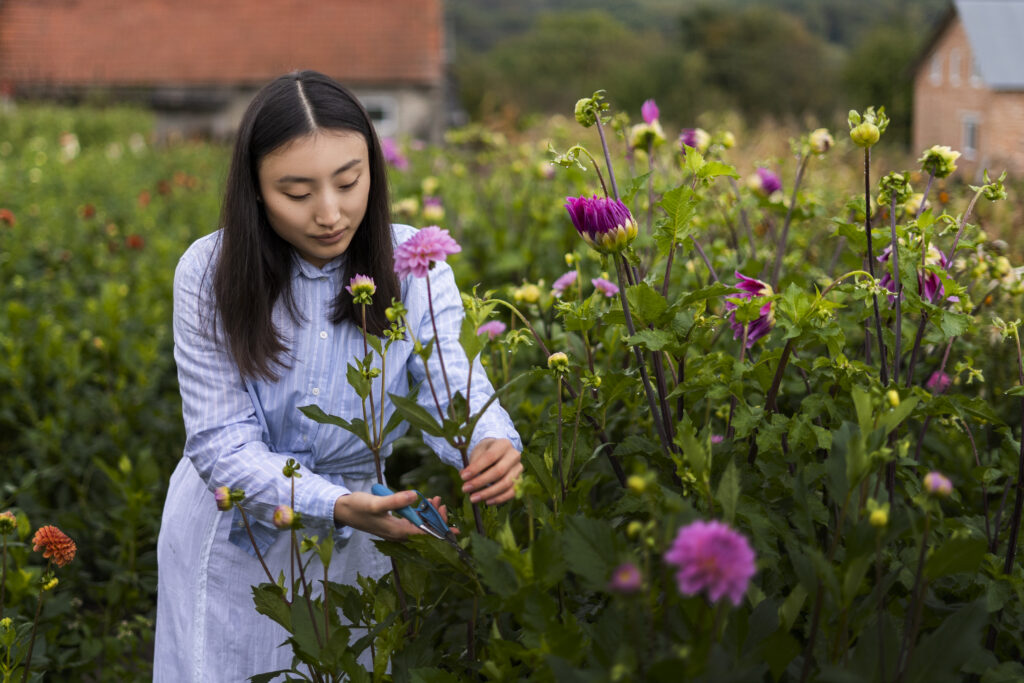
Of all the nutritional decisions a farmer makes across a growing season, few have as direct an impact on final yield and crop value as getting phosphorus timing at flowering right. Farmers who apply phosphorus on a fixed calendar schedule, treating it the same way across every growth stage, routinely leave yield on the table without understanding why. The flowering window is the most nutritionally sensitive period in the entire crop cycle, and what happens nutritionally in the two to three weeks surrounding flower initiation sets the trajectory for everything that follows, from fruit set percentage to final harvest weight and quality. Floral Designs brings the precision phosphorus products from Compo Expert Germany that give Indian farmers the tools to hit this window with exactly the right nutrition at exactly the right moment.
Why Phosphorus Is the Dominant Nutrient at Flowering
Every major nutrient plays a role in crop development, but each one has a phase of the crop cycle where its importance peaks above all others. For phosphorus, that phase is flowering and fruit set. Understanding why requires a brief look at what phosphorus actually does inside the plant at this stage.
Phosphorus is the primary driver of energy transfer within the plant. It forms the backbone of ATP, the molecule that powers virtually every metabolic process in plant cells. During the reproductive transition from vegetative to flowering growth, the plant’s energy demands surge as it initiates flower buds, develops pollen, and triggers the hormonal signals that drive fruit set. All of this activity runs on phosphorus-powered energy transfer at the cellular level.
Beyond energy metabolism, phosphorus is directly involved in cell division within developing flower buds and fruitlets. Adequate phosphorus at flower initiation supports the development of more flowers per plant, improves pollen viability and germination, and strengthens the biochemical signals that determine how many of those flowers successfully set fruit. A phosphorus shortfall at this exact moment does not just reduce flowering. It reduces the productive potential of the entire crop for the rest of the season.
What Happens When Phosphorus Timing at Flowering Is Wrong
The consequences of missing the phosphorus timing at flowering window are visible at harvest but originate weeks earlier during flower development. Farmers who apply phosphorus too late, after flowering has already peaked and fruit set has begun, miss the window where phosphorus can actually influence flower numbers and set percentage. The nutrient arrives when the critical decisions in the plant’s reproductive cycle have already been made.
Applying phosphorus too early is a less discussed but equally real problem. Phosphorus applied in granular form to the soil weeks before flowering is often fixed by soil chemistry, leached below the root zone, or consumed by vegetative growth before the crop reaches its reproductive phase. By the time the plant needs phosphorus most at flower initiation, the available supply in the root zone is already depleted and the next application has not yet been made.
The practical result of poor phosphorus timing is a crop that flowers unevenly, sets a lower percentage of its flowers as fruit, produces smaller and lighter fruit across the harvested population, and delivers a final yield well below what the season’s growing conditions would otherwise have supported.
The Case for Foliar Phosphorus at Flowering
The most reliable solution to the phosphorus timing at flowering challenge is foliar application of a fully water soluble phosphorus product in the two to three weeks surrounding flower initiation. Foliar application bypasses the soil chemistry issues that make granular phosphorus unreliable at this stage. The nutrient goes directly onto the leaf surface, is absorbed through the stomata and cuticle, and enters the plant’s vascular system within hours of application.
This speed and directness is exactly what the crop needs during the flowering window. There is no delay waiting for soil dissolution. There is no risk of phosphorus fixation by soil calcium, aluminium, or iron. The phosphorus the farmer applies reaches the plant at the moment it is needed, in a form the plant can use immediately for the energy-intensive processes of flower development and fruit set.
Foliar phosphorus at flowering also allows the farmer to adjust the timing based on actual crop development rather than a fixed calendar date. Different seasons, different field locations within the same farm, and different crop varieties all reach the flowering stage at slightly different times. Monitoring the crop and applying foliar phosphorus when the crop is actually approaching flower initiation gives far more reliable results than calendar-based applications that may or may not coincide with the crop’s real developmental stage.
Basfoliar 13-40-13 SP: The Precision Phosphorus Product for Flowering
Basfoliar 13-40-13 SP is the flagship flowering stage product in the Basfoliar range from Compo Expert Germany, available through Floral Designs. Its high phosphorus formulation with supporting nitrogen and potassium is designed specifically for foliar application during the pre-flowering and early fruit set stage.
The 13-40-13 ratio means phosphorus is the dominant nutrient in the formulation, present at more than three times the concentration of nitrogen and potassium. This makes it a targeted phosphorus delivery product rather than a general balanced fertiliser, which is exactly what the crop needs at this specific growth stage. The product dissolves completely in water without residue, ensuring the spray solution is uniform and the phosphorus concentration reaching each leaf surface is consistent across the entire application.
For mango farmers, applying Basfoliar 13-40-13 SP beginning one week before panicle emergence and continuing through early fruitlet development consistently improves panicle quality, pollen viability, and the percentage of flowers that develop into marketable fruit. Grape farmers in Maharashtra use this product during bunch initiation to improve berry set uniformity and reduce the percentage of shot berries that reduce bunch quality at harvest. Tomato and capsicum growers across Karnataka and Andhra Pradesh apply it at first flower bud appearance to push flower numbers and reduce flower drop under high temperature conditions.
Pairing Phosphorus with Boron at Flowering
One of the most reliable ways to amplify the effect of precise phosphorus timing at flowering is to apply boron alongside the phosphorus spray. Boron is a micronutrient that plays a specific role in pollen germination and pollen tube growth, the physical process by which pollen reaches the ovule to achieve fertilisation and trigger fruit set. Without adequate boron, pollen viability is reduced and pollen tube elongation is impaired, meaning even a well-timed phosphorus application cannot fully compensate for the fertilisation failure that boron deficiency causes.
Hydrospeed CaB Max delivers both calcium and boron through the drip line, supporting boron nutrition in the root zone consistently through the flowering period. For crops where boron deficiency is known to be a problem, running Hydrospeed CaB Max through the drip system in the weeks leading up to and through flowering, combined with foliar Basfoliar 13-40-13 SP applications, gives the crop the best possible nutritional support for maximising fruit set percentage.
Supporting Phosphorus Uptake with Seaweed Biostimulants
Getting the phosphorus timing right and choosing the right product are both essential, but the plant’s ability to actually absorb and utilise the phosphorus it receives is equally important. Under stress conditions including high temperatures, water stress, or heavy fruit load, the plant’s nutrient uptake efficiency drops even when the right nutrients are being applied at the right time.
Basfoliar Kelp O SL is a seaweed-based liquid fertiliser that improves the plant’s stress tolerance and nutrient uptake efficiency, making it a valuable addition to the flowering stage spray programme. Adding Basfoliar Kelp O SL to the tank alongside Basfoliar 13-40-13 SP during the flowering window helps the plant absorb and use the phosphorus being applied more efficiently, particularly during the high temperature periods that coincide with the flowering season for many Indian fruit crops.
What Comes After Flowering: Maintaining Momentum into Fruit Set
Precise phosphorus timing at flowering sets the crop up for better fruit set, but the nutrition programme cannot stop there. Once fruit set is confirmed and the crop moves into the early fruit development phase, the nutritional focus shifts toward supporting the rapid cell division happening in each developing fruitlet.
Continue foliar applications of Basfoliar 13-40-13 SP for two to three weeks after peak fruit set to support early fruitlet development. Then begin transitioning the programme toward potassium with Basfoliar K WP as the fruit enters the active bulking phase where potassium becomes the dominant nutritional driver of fruit sizing, colour, and quality.
For farms where a sustained nutritional foundation is needed across the full season alongside the targeted foliar programme, Basacote High K 6M applied as the basal granular fertiliser at the start of the season provides consistent background nutrition through the controlled release mechanism, ensuring the crop is never nutritionally depleted between targeted application events.
For detailed research on phosphorus nutrition and its role in flowering and fruit set across Indian horticultural crops, the Indian Society of Horticultural Research publishes agronomic research and crop-specific nutrition guidelines covering phosphorus management in fruit and vegetable production across India.
Browse all Basfoliar flowering stage products and the complete Compo Expert Germany range on the Floral Designs Shop. Learn more about the brand on the About Us page, and contact the team to get specific guidance on building a phosphorus programme for your crop and flowering timeline.
Conclusion
Phosphorus timing at flowering is one of the highest-leverage decisions in the entire crop nutrition calendar. Get it right and the crop sets more fruit, develops more uniformly, and delivers a harvest that reflects the effort and investment of the full growing season. Get it wrong and the losses compound from flowering all the way through to harvest without a clear explanation for why the season underperformed. Floral Designs gives Indian fruit and vegetable farmers access to Basfoliar 13-40-13 SP and the complete Compo Expert Germany range to make precise phosphorus management at flowering a practical reality on every farm, every season.